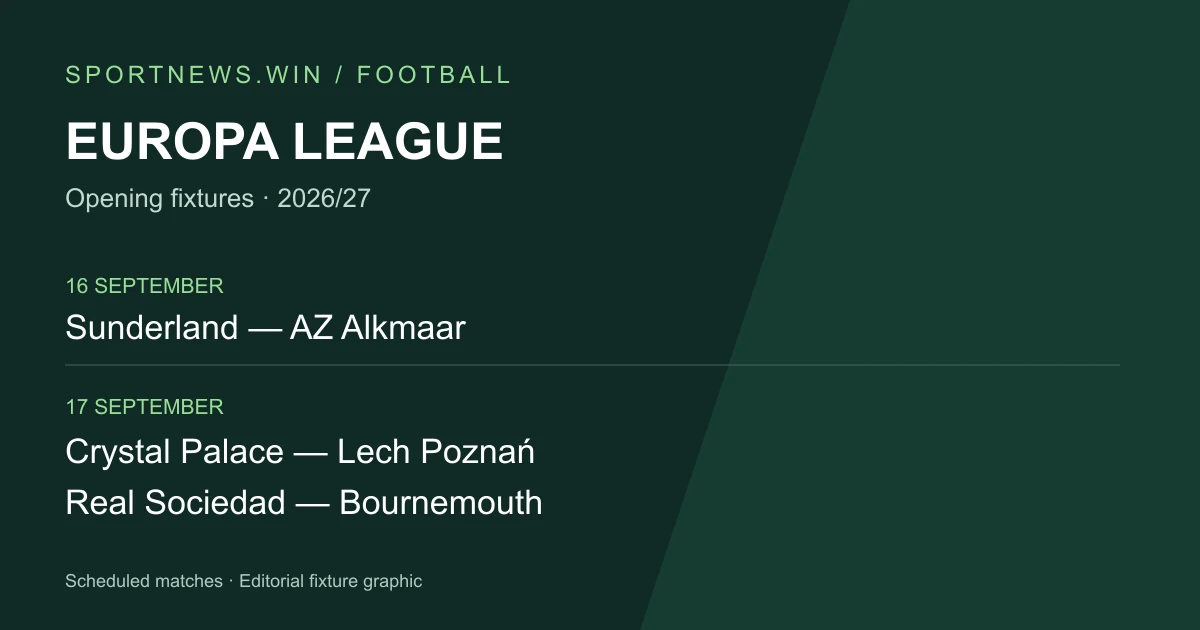
The Europa League returns on 16 September, with Sunderland opening their league-phase campaign at home to AZ Alkmaar. Crystal Palace host Lech Poznań the following day, while Bournemouth travel to Real Sociedad. The three English clubs therefore begin with different assignments: two home fixtures and one away trip. Those opening matches start a programme that continues into January, rather than deciding qualification over a single autumn block.
Three English clubs, different routes
The confirmed field contains 36 teams. Bournemouth earned their place by finishing sixth in England, while Sunderland finished seventh. Palace qualified as Conference League champions. Those distinctions matter when describing the competition: the two league qualifiers did not both finish in the top six, and Palace's entry follows a separate route.
The wider line-up includes Milan and Juventus from Italy, Marseille and Rennes from France, and Germany's Hoffenheim and Leverkusen. Direct entrants account for 13 places, including the Conference League title holders. Another 11 clubs arrived through Champions League qualifying, with 12 coming through Europa League qualifying. The opening round brings those different paths together on the same schedule.
The early fixtures to follow
Beyond the English clubs, Wednesday's programme includes Milan against Benfica and Anderlecht against Lyon. On Thursday, Juventus meet N.E.C. and Celtic play Ferencváros. This preview concerns scheduled fixtures; it does not treat any of those matches as a completed result.
Palace's next two appointments are both away: Lyon on 15 October and Beşiktaş on 22 October. Their November begins with a home match against Hoffenheim, followed by another home fixture against Real Sociedad later that month.
Bournemouth return home for Sturm Graz on 15 October and Milan a week later. Sunderland travel to Torreense and Lech Poznań on those same October matchdays. Their December programme includes an away match against Milan, before January brings Anderlecht away and Levski Sofia at home.
Analysis: the contrasting home-and-away sequences offer a useful starting point for following the three clubs. They do not establish which team has the easiest route. Results, rather than the familiarity of an opponent's name, will determine how each campaign develops. For wider domestic context, see our football coverage.
A calendar extending beyond Christmas
This is the third season of the league-phase system, not its introduction. Each club has eight opponents. After September's split opening round, matchdays fall on 15 and 22 October, 5 and 26 November, and 10 December. The final two rounds are scheduled for 21 and 28 January 2027, with all 18 concluding fixtures taking place simultaneously.
The knockout calendar then continues in February. Play-off legs are scheduled for 18 and 25 February, followed by the round of 16 on 11 and 18 March. April brings the quarter-finals; the semi-finals span late April and early May. Frankfurt is scheduled to stage the final on 26 May. Dates remain subject to change.
Questions before kick-off
When do the English teams begin?
Sunderland start on Wednesday, 16 September. Palace and Bournemouth begin on Thursday, 17 September. Their opponents are AZ Alkmaar, Lech Poznań and Real Sociedad respectively.
Does the league phase finish in December?
No. Two rounds remain in January, with the final matchday scheduled for 28 January 2027. December therefore marks a pause in the calendar rather than its conclusion.
Is this a new format for 2026/27?
No. The competition is entering its third season under the league-phase structure. This edition brings a fresh set of teams and fixtures within that established system.